

Audit overview
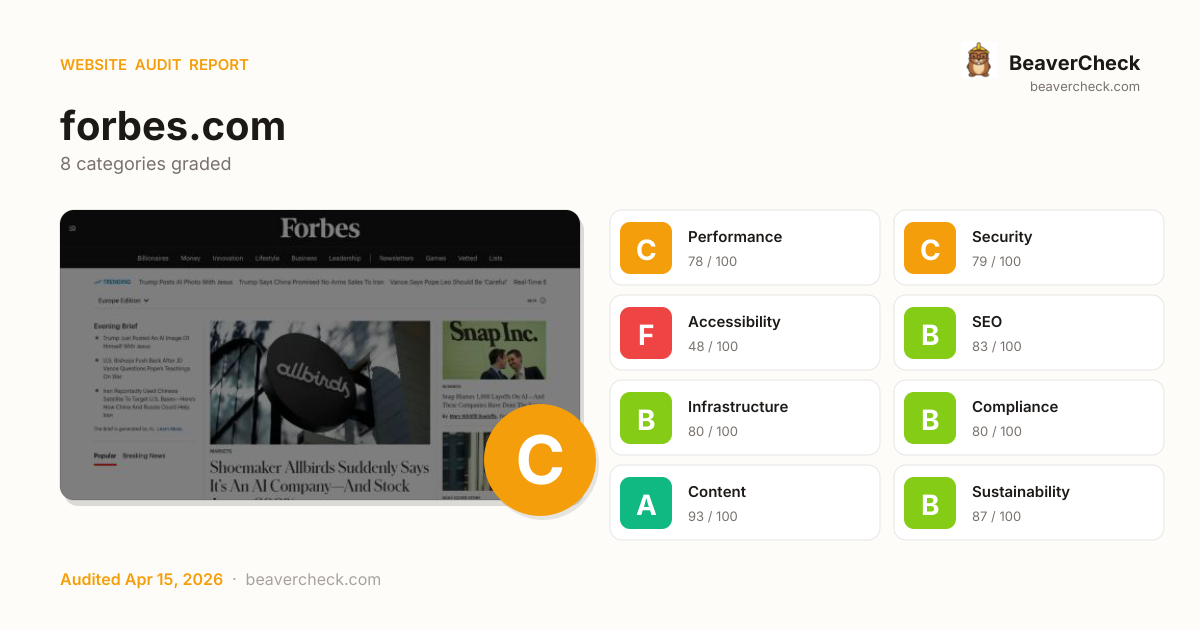
Accessibility needs attention; the rest of the categories are in good shape.
Fix Priority Matrix
5 findingsQuick Wins
4High impact, low effort — start here.
Strategic
1High impact, requires investment.
Easy Improvements
0Small gains, minimal effort.
Nothing in this quadrant — good news.
Deprioritize
0Low impact, high effort — do last.
Nothing in this quadrant — good news.
Screenshots


Top Priorities (5)
6 button(s) with no accessible text
Buttons with no accessible text (icon-only, no aria-label) can't be activated by voice control or understood by screen readers.
No <main> landmark found
Without a <main> landmark, screen-reader users can't skip past the navigation to the page content — every page starts with re-reading the menu.
Soft 404: server returns HTTP 200 for non-existent pages
Soft 404s (HTTP 200 for missing pages) confuse Google — it indexes the 'not found' page as real content and ranks it.
70 third-party resources (100% of weight)
Informational: third-party resource count and their share of page weight. High share caps perf gains from frontend optimization.
Cross-Origin-Embedder-Policy header is missing
COEP enforces that all embedded resources opt-in to cross-origin embedding — required for cross-origin isolation features.
Business case
What fixing the audit's findings is worth -- and what ignoring them keeps costing.
Return on investment
€184 investment → €10,753/month returns + EUR 120,500,000 risk avoided
Figures combine localized regulatory fine ceilings, search/conversion value priced against local CPC, and bandwidth waste estimates. Results depend on implementation quality and audience composition. Not legal or financial advice.
Conversion barriers
4 barrier(s) likely increasing bounce by ~27%.
- Page takes 12.2s to loadUsers abandon at ~3s — you're 9.7s over the 2.5s threshold→ Optimize render-blocking resources, preload the hero image, and compress images
- Page feels frozen for 1.2sClicks on the primary CTA are ignored while JavaScript runs→ Break up long tasks; defer non-critical JavaScript to post-hydration
- 4 broken link(s) on the pageClicks land on 404s — trust drops and the session often ends→ Fix or remove the broken destinations surfaced on the Content tab
- No skip-to-content linkKeyboard and screen-reader users must tab through the entire header on every page→ Add a visible-on-focus <a href="#main">Skip to content</a> as the first focusable element
Preliminary CRO audit — each barrier links to the tab with detailed analysis.
Remediation cost
Start here for the best return on investment
Cost by category
Cost by effort level
Adjust assumptions
Team composition
Multiplier applied to dev hours to reflect QA, design, and PM overhead. Use Dev only for solo work; Full team for projects with formal review processes.
Rates reflect fully-loaded developer cost including overhead
Warning:Cost of inaction
Compliance Risk
€120.500.000
- No privacy policy link detectedGDPR: EUR 10.000 – EUR 20.000.000
- Trackers detected but no cookie policy foundGDPR: EUR 5.000 – EUR 10.000.000
- Trackers detected but no cookie policy foundGDPR: EUR 10.000 – EUR 20.000.000
Bounce-Rate Cost
€8.676 /mo
+26.8pp bounce · ~2,677 lost visitors/mo
CPC: EUR 3.24
Bandwidth Waste
€0,35 /mo
4675.5 MB/mo × 0.074 EUR/GB
- Optimize transfer: save ~468 KB per page loadSaves €0,35/mo
Compliance figures represent the statutory maximum fine for the most severe triggered category, capped per regulation — not the sum of per-finding penalties. Based on published regulatory fine ranges. This is not legal advice.
Unique monthly visitors from your analytics
Purchases, signups, or key actions
Optional — for revenue estimation
more engaged visitors from reduced bounce
Fix 3 critical issues to capture this value
How this is calculated
Based on Google/Deloitte research ("Milliseconds Make Millions") showing a ~7% bounce rate increase per additional second of LCP above the 2.5s "Good" threshold.
Your site's LCP: → estimated after fixes.
These are estimates based on industry research — actual results vary
Your data stays in your browser — nothing is sent to our servers
Lighthouse
Mobile
First Contentful Paint First Contentful Paint — how long until the browser renders the first piece of content. Under 1.8s is good.
4.51 s
Largest Contentful Paint Largest Contentful Paint — how long until the largest visible element loads. Under 2.5s is good.
12.23 s
Total Blocking Time Total Blocking Time — total time the main thread was blocked, preventing user input. Under 200ms is good.
1.16 s
Cumulative Layout Shift Cumulative Layout Shift — measures visual stability. How much the page layout shifts during loading. Under 0.1 is good.
0.000
Speed Index Speed Index — how quickly content is visually displayed during load. Under 3.4s is good.
7.55 s
Time to Interactive Time to Interactive — how long until the page is fully interactive and responds to user input. Under 3.8s is good.
12.25 s
Desktop
First Contentful Paint First Contentful Paint — how long until the browser renders the first piece of content. Under 1.8s is good.
894 ms
Largest Contentful Paint Largest Contentful Paint — how long until the largest visible element loads. Under 2.5s is good.
1.71 s
Total Blocking Time Total Blocking Time — total time the main thread was blocked, preventing user input. Under 200ms is good.
64 ms
Cumulative Layout Shift Cumulative Layout Shift — measures visual stability. How much the page layout shifts during loading. Under 0.1 is good.
0.000
Speed Index Speed Index — how quickly content is visually displayed during load. Under 3.4s is good.
1.99 s
Time to Interactive Time to Interactive — how long until the page is fully interactive and responds to user input. Under 3.8s is good.
1.83 s
Categories
8Performance
70 third-party resources (100% of weight)
Security
Cross-Origin-Embedder-Policy header is missing
Accessibility
6 button(s) with no accessible text
SEO
All checks pass
Infrastructure
All checks pass
Compliance
All checks pass
Content
All checks pass
Sustainability
All checks pass
How you compare
Where this site stands against peers running the same stack.
Top 10% of Amazon Route 53 sites score 93+ on Infrastructure; you're at 80 — closing this gap is the highest-leverage improvement.
Top 10% of Apple sites score 73+ on Accessibility; you're at 48 — closing this gap is the highest-leverage improvement.
Technology stack
Amazon Route 53, hosted on Next.js, with Amazon Associates CDN
Stack Architecture
 Google Tag Manager
  HTTP/3 Microsoft Mimecast
  Open Graph
  Priority Hints
  React
React  Swiper
  Varnish
  Webpack
  core-js 3.9.1
 Amazon Associates
  Fastly
  Next.js 14.2.32
All Detected Technologies (18)
Amazon Associates is an affiliate marketing program that allows website owners and bloggers to create links and earn referral fees when customers click through and buy products from Amazon.
Next.js is a React framework for developing single page Javascript applications.
HTTP Strict Transport Security (HSTS) informs browsers that the site should only be accessed using HTTPS.
HTTP/3 is the third major version of the Hypertext Transfer Protocol used to exchange information on the World Wide Web.
Open Graph is a protocol that is used to integrate any web page into the social graph.
Priority Hints exposes a mechanism for developers to signal a relative priority for browsers to consider when fetching resources.
React is an open-source JavaScript library for building user interfaces or UI components.
Swiper is a JavaScript library that creates modern touch sliders with hardware-accelerated transitions.
Varnish is a reverse caching proxy.
Webpack is an open-source JavaScript module bundler.
core-js is a modular standard library for JavaScript, with polyfills for cutting-edge ECMAScript features.
Google Tag Manager is a tag management system (TMS) that allows you to quickly and easily update measurement codes and related code fragments collectively known as tags on your website or mobile app.
Observations (2)
No build tool detected
A framework (Amazon Route 53) was detected but no bundler was identified. The build tool may not be detectable from output patterns, or the site may use the framework's built-in bundler.
Complex technology stack detected
18 technologies identified. A complex stack increases maintenance burden and attack surface. Consider whether all components are actively needed.
Show your score
Drop this badge on your README, marketing site, or status page. It auto-updates every time the audit re-runs and links back to this report.

This badge auto-updates with your latest scan result.
[](https://beavercheck.com/sites/forbes.com)<a href="https://beavercheck.com/sites/forbes.com"><img src="https://beavercheck.com/badge?url=https%3A%2F%2Fforbes.com" alt="BeaverCheck Score"></a>https://beavercheck.com/badge?url=https%3A%2F%2Fforbes.comExport & share
Download the audit, share with your team, or grab a fix plan ready to copy into your tracker.
Copies markdown to clipboard
Fix Plan
Three-week roadmap to ship the audit's findings, with one-click copy targets for your tracker.
Three-week fix plan
2 sprints · 2h total → projected B (81)
Sprint 1: Quick Wins
+4Highest ROI — low effort, high impact
- · No <main> landmark found
- · 6 button(s) with no accessible text
- · Soft 404: server returns HTTP 200 for non-existent pages
- · 70 third-party resources (100% of weight)
Sprint 2: Core Fixes
+1Medium effort, high structural impact
- · Cross-Origin-Embedder-Policy header is missing