Skip to content
Audit Complete

Results for https://wordpress.org

Visit site
United Stated United Stated · New York Completed: Apr 4, 2026 16:29 UTC

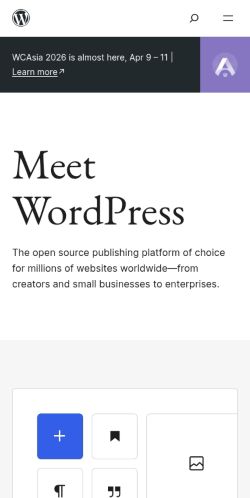
Mobile 375 × 812

Screenshot of the audited page (Mobile 375×812)

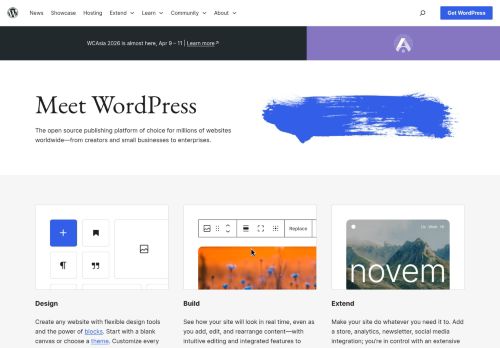
Desktop 1440 × 900

Screenshot of the audited page (Desktop 1440×900)
B80

Site Health

Score: 80 / 100

Based on 8 categories, 0 sections

How is this calculated?

The overall score is a weighted average of individual category scores. Categories with more impact on user experience and security carry more weight.

Performance 25%Security 25%Accessibility 15%SEO 10%Infrastructure 10%Compliance 8%Content 5%Sustainability 2%

Weights reflect general web best practices. Individual needs may differ.

Top Priorities (5)

1

Content-Security-Policy header is missing

Security › Security Headers
2

No Content-Security-Policy header found

Security › Content Security Policy
3

1 link(s) with no accessible text

Accessibility › Link & Button Quality
4

Cross-Origin-Embedder-Policy header is missing

Security › Security Headers
5

Cross-Origin-Opener-Policy header is missing

Security › Security Headers
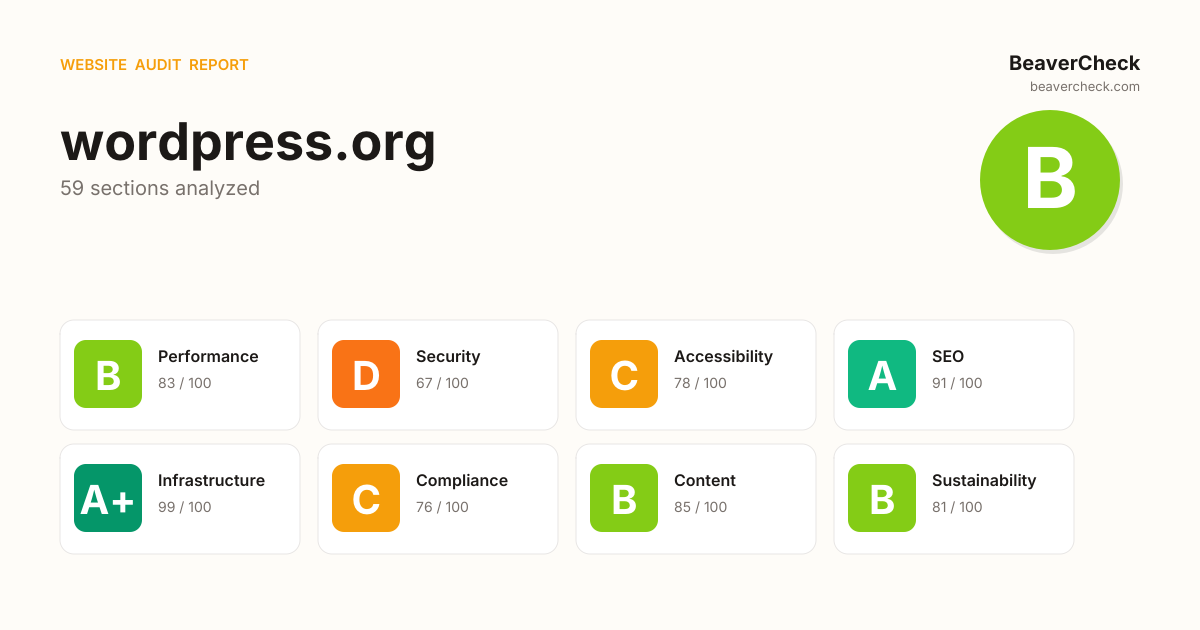
BeaverCheck badge
Embed this badge
[![BeaverCheck](https://beavercheck.com/badge?url=https%3A%2F%2Fwordpress.org)](https://beavercheck.com/results/3664ab66-ee51-4bcc-8bc1-2738eaa1fa81)
<a href="https://beavercheck.com/results/3664ab66-ee51-4bcc-8bc1-2738eaa1fa81"><img src="https://beavercheck.com/badge?url=https%3A%2F%2Fwordpress.org" alt="BeaverCheck Score"></a>
https://beavercheck.com/badge?url=https%3A%2F%2Fwordpress.org

This badge auto-updates with your latest scan result.

Was this report useful?

Thanks for your feedback!

Lighthouse Scores

Industry-standard audits powered by Google Lighthouse.

72
Performance Overall performance score (0–100) based on Core Web Vitals and other metrics. 90+ is good.
92
Accessibility Measures how accessible the page is for users with disabilities. Checks color contrast, ARIA labels, and semantic HTML.
100
Best Practices Checks for modern web development best practices including HTTPS, no console errors, and secure JavaScript.
92
SEO Measures basic SEO optimizations: meta tags, crawlability, link text, and mobile friendliness.

Core Web Vitals

Key metrics that affect user experience.

First Contentful Paint First Contentful Paint — how long until the browser renders the first piece of content. Under 1.8s is good.

1.98 s

Largest Contentful Paint Largest Contentful Paint — how long until the largest visible element loads. Under 2.5s is good.

5.95 s

Total Blocking Time Total Blocking Time — total time the main thread was blocked, preventing user input. Under 200ms is good.

230 ms

Cumulative Layout Shift Cumulative Layout Shift — measures visual stability. How much the page layout shifts during loading. Under 0.1 is good.

0.000

Speed Index Speed Index — how quickly content is visually displayed during load. Under 3.4s is good.

1.98 s

Time to Interactive Time to Interactive — how long until the page is fully interactive and responds to user input. Under 3.8s is good.

6.50 s

Detailed Report

Audit breakdown by category with detailed findings.

72

Performance

Insights

Remove large, duplicate JavaScript modules from bundles to reduce unnecessary bytes consumed by network activity.

Polyfills and transforms enable older browsers to use new JavaScript features. However, many aren't necessary for modern browsers. Consider modifying your JavaScript build process to not transpile Baseline features, unless you know you must support older browsers. Learn why most sites can deploy ES6+ code without transpiling

3rd party code can significantly impact load performance. Reduce and defer loading of 3rd party code to prioritize your page's content.

Reducing the download time of images can improve the perceived load time of the page and LCP. Learn more about optimizing image size

URLResource SizeEst Savings
div.wp-block-columns > div.wp-block-column > figure.wp-block-image > img.wp-image-48980 div.wp-block-columns > div.wp-block-column > figure.wp-block-image > img.wp-image-48980
i0.wp.com/wordpress.org/files/2025/12/wporg-69-new.png?resize=768%2C540&ssl=1182.1 KiB133.6 KiB
A black and white photograph of excited, applauding attendees in the audience a… div.wp-block-columns > div.wp-block-column > figure.wp-block-image > img.wp-image-39810
/wordpress.org/files/2024/04/photo-community-1.png?resize...154.5 KiB120.9 KiB
div.wp-block-group > figure.wp-block-image > a > img.wp-image-50259 div.wp-block-group > figure.wp-block-image > a > img.wp-image-50259
i0.wp.com/wordpress.org/files/2026/03/WCA26-Icon-Purple-White.png?w=705&ssl=195.1 KiB94.2 KiB
div.wp-block-group > div.wp-block-group > figure.wp-block-image > img.wp-image-22641 div.wp-block-group > div.wp-block-group > figure.wp-block-image > img.wp-image-22641
/wordpress.org/files/2023/10/showcase-middle-row.png?resi...92.4 KiB74.8 KiB
div.wp-block-group > div.wp-block-group > figure.wp-block-image > img.wp-image-22644 div.wp-block-group > div.wp-block-group > figure.wp-block-image > img.wp-image-22644
/wordpress.org/files/2023/10/showcase-top-row-full.png?re...87.2 KiB69.8 KiB
div.wp-block-columns > div.wp-block-column > figure.wp-block-image > img.wp-image-48981 div.wp-block-columns > div.wp-block-column > figure.wp-block-image > img.wp-image-48981
i0.wp.com/wordpress.org/files/2025/12/wporg-69-publish.png?w=720&ssl=196.0 KiB51.9 KiB
div.wp-block-group > div.wp-block-group > figure.wp-block-image > img.wp-image-22642 div.wp-block-group > div.wp-block-group > figure.wp-block-image > img.wp-image-22642
/wordpress.org/files/2023/10/showcase-bottom-row.png?resi...44.1 KiB30.1 KiB
NASA logo div.wp-block-group > div.wp-block-group > figure.wp-block-image > img.wp-image-22635
wordpress.org/files/2023/10/NASA-1.png10.8 KiB7.0 KiB

Optimize LCP by making the LCP image discoverable from the HTML immediately, and avoiding lazy-loading

lhId: page-8-IMG
nodeLabel: div.wp-block-columns > div.wp-block-column > figure.wp-block-image > img.wp-image-48979
path: 1,HTML,1,BODY,2,DIV,1,MAIN,3,DIV,0,DIV,0,DIV,0,FIGURE,0,IMG
selector: div.wp-block-columns > div.wp-block-column > figure.wp-block-image > img.wp-image-48979
snippet: <img width="720" height="460" src="https://i0.wp.com/wordpress.org/files/2025/12/wporg-69-design.png?w=720&amp;ss…" alt="" class="wp-image-48979" srcset="https://i0.wp.com/wordpress.org/files/2025/12/wporg-69-design.png?w=720&amp;ss…" sizes="(max-width: 720px) 100vw, 720px">

Avoid chaining critical requests by reducing the length of chains, reducing the download size of resources, or deferring the download of unnecessary resources to improve page load.

description: [preconnect](https://developer.chrome.com/docs/lighthouse/performance/uses-rel-preconnect/) hints help the browser establish a connection earlier in the page load, saving time when the first request for that origin is made. The following are the origins that the page preconnected to.
title: Preconnected origins
description: Add [preconnect](https://developer.chrome.com/docs/lighthouse/performance/uses-rel-preconnect/) hints to your most important origins, but try to use no more than 4.
title: Preconnect candidates
value: No additional origins are good candidates for preconnecting

These insights are also available in the Chrome DevTools Performance Panel - record a trace to view more detailed information.

The maximum potential First Input Delay that your users could experience is the duration of the longest task. Learn more about the Maximum Potential First Input Delay metric.

Time to Interactive is the amount of time it takes for the page to become fully interactive. Learn more about the Time to Interactive metric.

TTI

Diagnostics

Reduce unused rules from stylesheets and defer CSS not used for above-the-fold content to decrease bytes consumed by network activity. Learn how to reduce unused CSS.

Reduce unused JavaScript and defer loading scripts until they are required to decrease bytes consumed by network activity. Learn how to reduce unused JavaScript.

Estimated savings: 0.0 ms 128.6 KiB

More information about the performance of your application. These numbers don't directly affect the Performance score.

Layout shift culprits
Document request latency
Optimize DOM size
Font display
Forced reflow
LCP breakdown
Modern HTTP
Optimize viewport for mobile
Minify CSS
Minify JavaScript
Avoids enormous network payloads Total size was 1,647 KiB
User Timing marks and measures 5 user timings
JavaScript execution time 0.7 s
Minimizes main-thread work 1.6 s
Avoid long main-thread tasks 5 long tasks found
Image elements have explicit `width` and `height`
Page didn't prevent back/forward cache restoration
Network Requests
Network Round Trip Times 10 ms
Server Backend Latencies 30 ms
Tasks
Diagnostics
Metrics
Screenshot Thumbnails
Final Screenshot
Script Treemap Data
Resources Summary
Avoid multiple page redirects
Initial server response time was short Root document took 20 ms
INP breakdown
Avoid non-composited animations
Avoid large layout shifts
92

Accessibility

These checks highlight opportunities to improve the accessibility of your web app. Automatic detection can only detect a subset of issues and does not guarantee the accessibility of your web app, so manual testing is also encouraged.

Contrast

Low-contrast text is difficult or impossible for many users to read. Link text that is discernible improves the experience for users with low vision. Learn how to make links distinguishable.

Failing Elements
EVENTS ul.is-3-column > li > div.wp-block-wporg-latest-news__details > a.wp-block-wporg-latest-news__category

These are opportunities to improve the legibility of your content.

Names and labels

Link text (and alternate text for images, when used as links) that is discernible, unique, and focusable improves the navigation experience for screen reader users. Learn how to make links accessible.

Failing Elements
div.wp-block-group > div.wp-block-group > figure.wp-block-image > a div.wp-block-group > div.wp-block-group > figure.wp-block-image > a

These are opportunities to improve the semantics of the controls in your application. This may enhance the experience for users of assistive technology, like a screen reader.

Interactive controls are keyboard focusable
Interactive elements indicate their purpose and state
The page has a logical tab order
Visual order on the page follows DOM order
User focus is not accidentally trapped in a region
The user's focus is directed to new content added to the page
HTML5 landmark elements are used to improve navigation
Offscreen content is hidden from assistive technology
Custom controls have associated labels
Custom controls have ARIA roles
`[aria-*]` attributes match their roles
`[aria-hidden="true"]` is not present on the document `<body>`
`[role]`s have all required `[aria-*]` attributes
`[role]` values are valid
`[aria-*]` attributes have valid values
`[aria-*]` attributes are valid and not misspelled
Buttons have an accessible name
Image elements have `[alt]` attributes
`[user-scalable="no"]` is not used in the `<meta name="viewport">` element and the `[maximum-scale]` attribute is not less than 5.
ARIA attributes are used as specified for the element's role
`[aria-hidden="true"]` elements do not contain focusable descendents
Elements use only permitted ARIA attributes
Background and foreground colors have a sufficient contrast ratio
Document has a `<title>` element
`<html>` element has a `[lang]` attribute
`<html>` element has a valid value for its `[lang]` attribute
Lists contain only `<li>` elements and script supporting elements (`<script>` and `<template>`).
List items (`<li>`) are contained within `<ul>`, `<ol>` or `<menu>` parent elements
Touch targets have sufficient size and spacing.
Heading elements appear in a sequentially-descending order
Skip links are focusable.
Document has a main landmark.
Deprecated ARIA roles were not used
Identical links have the same purpose.
`[accesskey]` values are unique
`button`, `link`, and `menuitem` elements have accessible names
Elements with `role="dialog"` or `role="alertdialog"` have accessible names.
ARIA input fields have accessible names
ARIA `meter` elements have accessible names
ARIA `progressbar` elements have accessible names
Elements with an ARIA `[role]` that require children to contain a specific `[role]` have all required children.
`[role]`s are contained by their required parent element
Elements with the `role=text` attribute do not have focusable descendents.
ARIA toggle fields have accessible names
ARIA `tooltip` elements have accessible names
ARIA `treeitem` elements have accessible names
The page contains a heading, skip link, or landmark region
`<dl>`'s contain only properly-ordered `<dt>` and `<dd>` groups, `<script>`, `<template>` or `<div>` elements.
Definition list items are wrapped in `<dl>` elements
ARIA IDs are unique
No form fields have multiple labels
`<frame>` or `<iframe>` elements have a title
`<html>` element has an `[xml:lang]` attribute with the same base language as the `[lang]` attribute.
Input buttons have discernible text.
`<input type="image">` elements have `[alt]` text
Form elements have associated labels
The document does not use `<meta http-equiv="refresh">`
`<object>` elements have alternate text
Select elements have associated label elements.
No element has a `[tabindex]` value greater than 0
Cells in a `<table>` element that use the `[headers]` attribute refer to table cells within the same table.
`<th>` elements and elements with `[role="columnheader"/"rowheader"]` have data cells they describe.
`[lang]` attributes have a valid value
`<video>` elements contain a `<track>` element with `[kind="captions"]`
Tables have different content in the summary attribute and `<caption>`.
All heading elements contain content.
Uses ARIA roles only on compatible elements
Image elements do not have `[alt]` attributes that are redundant text.
Elements with visible text labels have matching accessible names.
Tables use `<caption>` instead of cells with the `[colspan]` attribute to indicate a caption.
`<td>` elements in a large `<table>` have one or more table headers.
100

Best Practices

Uses HTTPS
Avoids deprecated APIs
Avoids third-party cookies
Allows users to paste into input fields
Avoids requesting the geolocation permission on page load
Avoids requesting the notification permission on page load
Displays images with correct aspect ratio
Serves images with appropriate resolution
Page has the HTML doctype
Properly defines charset
No browser errors logged to the console
No issues in the `Issues` panel in Chrome Devtools
Ensure CSP is effective against XSS attacks
Use a strong HSTS policy
Ensure proper origin isolation with COOP
Mitigate DOM-based XSS with Trusted Types
Detected JavaScript libraries
Page has valid source maps
Redirects HTTP traffic to HTTPS
Mitigate clickjacking with XFO or CSP
92

SEO

These checks ensure that your page is following basic search engine optimization advice. There are many additional factors Lighthouse does not score here that may affect your search ranking, including performance on Core Web Vitals. Learn more about Google Search Essentials.

Content Best Practices

Descriptive link text helps search engines understand your content. Learn how to make links more accessible.

Link destinationLink Text
asia.wordcamp.org/2026/Learn more

Format your HTML in a way that enables crawlers to better understand your app’s content.

Structured data is valid
Page isn’t blocked from indexing
Document has a `<title>` element
Document has a meta description
Page has successful HTTP status code
Links are crawlable
robots.txt is valid
Image elements have `[alt]` attributes
Document has a valid `hreflang`
Document has a valid `rel=canonical`

Lighthouse Scores

Industry-standard audits powered by Google Lighthouse. — Desktop

97
Performance Overall performance score (0–100) based on Core Web Vitals and other metrics. 90+ is good.
93
Accessibility Measures how accessible the page is for users with disabilities. Checks color contrast, ARIA labels, and semantic HTML.
100
Best Practices Checks for modern web development best practices including HTTPS, no console errors, and secure JavaScript.
92
SEO Measures basic SEO optimizations: meta tags, crawlability, link text, and mobile friendliness.

Core Web Vitals

Key metrics that affect user experience. — Desktop

First Contentful Paint First Contentful Paint — how long until the browser renders the first piece of content. Under 1.8s is good.

482 ms

Largest Contentful Paint Largest Contentful Paint — how long until the largest visible element loads. Under 2.5s is good.

1.23 s

Total Blocking Time Total Blocking Time — total time the main thread was blocked, preventing user input. Under 200ms is good.

18 ms

Cumulative Layout Shift Cumulative Layout Shift — measures visual stability. How much the page layout shifts during loading. Under 0.1 is good.

0.000

Speed Index Speed Index — how quickly content is visually displayed during load. Under 3.4s is good.

548 ms

Time to Interactive Time to Interactive — how long until the page is fully interactive and responds to user input. Under 3.8s is good.

1.34 s

Detailed Report

Audit breakdown by category with detailed findings.

97

Performance

Insights

Remove large, duplicate JavaScript modules from bundles to reduce unnecessary bytes consumed by network activity.

Polyfills and transforms enable older browsers to use new JavaScript features. However, many aren't necessary for modern browsers. Consider modifying your JavaScript build process to not transpile Baseline features, unless you know you must support older browsers. Learn why most sites can deploy ES6+ code without transpiling

3rd party code can significantly impact load performance. Reduce and defer loading of 3rd party code to prioritize your page's content.

A forced reflow occurs when JavaScript queries geometric properties (such as offsetWidth) after styles have been invalidated by a change to the DOM state. This can result in poor performance. Learn more about forced reflows and possible mitigations.

headings: [map[key:source label:Source valueType:source-location] map[granularity:1 key:reflowTime label:Total reflow time valueType:ms]]
items: [map[reflowTime:71.053 source:map[type:text value:[unattributed]]]]

Reducing the download time of images can improve the perceived load time of the page and LCP. Learn more about optimizing image size

URLResource SizeEst Savings
A black and white photograph of excited, applauding attendees in the audience a… div.wp-block-columns > div.wp-block-column > figure.wp-block-image > img.wp-image-39810
i0.wp.com/wordpress.org/files/2024/04/photo-community-1.png?w=1216&ssl=1356.0 KiB333.7 KiB
div.wp-block-group > div.wp-block-group > figure.wp-block-image > img.wp-image-22641 div.wp-block-group > div.wp-block-group > figure.wp-block-image > img.wp-image-22641
/wordpress.org/files/2023/10/showcase-middle-row.png?resi...333.1 KiB278.7 KiB
div.wp-block-group > div.wp-block-group > figure.wp-block-image > img.wp-image-22644 div.wp-block-group > div.wp-block-group > figure.wp-block-image > img.wp-image-22644
/wordpress.org/files/2023/10/showcase-top-row-full.png?re...304.0 KiB250.2 KiB
div.wp-block-columns > div.wp-block-column > figure.wp-block-image > img.wp-image-48980 div.wp-block-columns > div.wp-block-column > figure.wp-block-image > img.wp-image-48980
i0.wp.com/wordpress.org/files/2025/12/wporg-69-new.png?w=1080&ssl=1158.7 KiB124.1 KiB
div.wp-block-columns > div.wp-block-column > figure.wp-block-image > img.wp-image-39758 div.wp-block-columns > div.wp-block-column > figure.wp-block-image > img.wp-image-39758
i0.wp.com/wordpress.org/files/2024/04/brush.png?w=1198&ssl=1127.8 KiB114.3 KiB
div.wp-block-group > div.wp-block-group > figure.wp-block-image > img.wp-image-22642 div.wp-block-group > div.wp-block-group > figure.wp-block-image > img.wp-image-22642
/wordpress.org/files/2023/10/showcase-bottom-row.png?resi...148.9 KiB105.8 KiB
div.wp-block-group > figure.wp-block-image > a > img.wp-image-50259 div.wp-block-group > figure.wp-block-image > a > img.wp-image-50259
i0.wp.com/wordpress.org/files/2026/03/WCA26-Icon-Purple-White.png?w=705&ssl=195.1 KiB94.6 KiB
div.wp-block-columns > div.wp-block-column > figure.wp-block-image > img.wp-image-48981 div.wp-block-columns > div.wp-block-column > figure.wp-block-image > img.wp-image-48981
i0.wp.com/wordpress.org/files/2025/12/wporg-69-publish.png?w=720&ssl=196.0 KiB82.5 KiB
div.wp-block-columns > div.wp-block-column > figure.wp-block-image > img.wp-image-48978 div.wp-block-columns > div.wp-block-column > figure.wp-block-image > img.wp-image-48978
i0.wp.com/wordpress.org/files/2025/12/wporg-69-build.png?w=720&ssl=149.9 KiB37.4 KiB
NASA logo div.wp-block-group > div.wp-block-group > figure.wp-block-image > img.wp-image-22635
wordpress.org/files/2023/10/NASA-1.png10.8 KiB9.5 KiB

Optimize LCP by making the LCP image discoverable from the HTML immediately, and avoiding lazy-loading

lhId: page-4-IMG
nodeLabel: div.wp-block-columns > div.wp-block-column > figure.wp-block-image > img.wp-image-39758
path: 1,HTML,1,BODY,2,DIV,1,MAIN,1,DIV,0,DIV,1,DIV,0,FIGURE,0,IMG
selector: div.wp-block-columns > div.wp-block-column > figure.wp-block-image > img.wp-image-39758
snippet: <img width="1198" height="323" src="https://i0.wp.com/wordpress.org/files/2024/04/brush.png?w=1198&amp;ssl=1" alt="" class="wp-image-39758" srcset="https://i0.wp.com/wordpress.org/files/2024/04/brush.png?w=1198&amp;ssl=1 1198w…" sizes="(max-width: 1198px) 100vw, 1198px">

Avoid chaining critical requests by reducing the length of chains, reducing the download size of resources, or deferring the download of unnecessary resources to improve page load.

description: [preconnect](https://developer.chrome.com/docs/lighthouse/performance/uses-rel-preconnect/) hints help the browser establish a connection earlier in the page load, saving time when the first request for that origin is made. The following are the origins that the page preconnected to.
title: Preconnected origins
description: Add [preconnect](https://developer.chrome.com/docs/lighthouse/performance/uses-rel-preconnect/) hints to your most important origins, but try to use no more than 4.
title: Preconnect candidates
value: No additional origins are good candidates for preconnecting

These insights are also available in the Chrome DevTools Performance Panel - record a trace to view more detailed information.

Diagnostics

Reduce unused rules from stylesheets and defer CSS not used for above-the-fold content to decrease bytes consumed by network activity. Learn how to reduce unused CSS.

Reduce unused JavaScript and defer loading scripts until they are required to decrease bytes consumed by network activity. Learn how to reduce unused JavaScript.

Estimated savings: 0.0 ms 129.9 KiB

More information about the performance of your application. These numbers don't directly affect the Performance score.

Max Potential First Input Delay 90 ms
Time to Interactive 1.3 s
Use efficient cache lifetimes
Layout shift culprits
Document request latency
Optimize DOM size
Font display
LCP breakdown
Modern HTTP
Optimize viewport for mobile
Minify CSS
Minify JavaScript
Avoids enormous network payloads Total size was 2,456 KiB
User Timing marks and measures 5 user timings
JavaScript execution time 0.2 s
Minimizes main-thread work 0.4 s
Avoid long main-thread tasks 1 long task found
Image elements have explicit `width` and `height`
Page didn't prevent back/forward cache restoration
Network Requests
Network Round Trip Times 10 ms
Server Backend Latencies 40 ms
Tasks
Diagnostics
Metrics
Screenshot Thumbnails
Final Screenshot
Script Treemap Data
Resources Summary
Avoid multiple page redirects
Initial server response time was short Root document took 20 ms
INP breakdown
Avoid non-composited animations
Avoid large layout shifts
93

Accessibility

These checks highlight opportunities to improve the accessibility of your web app. Automatic detection can only detect a subset of issues and does not guarantee the accessibility of your web app, so manual testing is also encouraged.

Contrast

Low-contrast text is difficult or impossible for many users to read. Link text that is discernible improves the experience for users with low vision. Learn how to make links distinguishable.

Failing Elements
EVENTS ul.is-3-column > li > div.wp-block-wporg-latest-news__details > a.wp-block-wporg-latest-news__category

These are opportunities to improve the legibility of your content.

Names and labels

Link text (and alternate text for images, when used as links) that is discernible, unique, and focusable improves the navigation experience for screen reader users. Learn how to make links accessible.

Failing Elements
div.wp-block-group > div.wp-block-group > figure.wp-block-image > a div.wp-block-group > div.wp-block-group > figure.wp-block-image > a

These are opportunities to improve the semantics of the controls in your application. This may enhance the experience for users of assistive technology, like a screen reader.

Interactive controls are keyboard focusable
Interactive elements indicate their purpose and state
The page has a logical tab order
Visual order on the page follows DOM order
User focus is not accidentally trapped in a region
The user's focus is directed to new content added to the page
HTML5 landmark elements are used to improve navigation
Offscreen content is hidden from assistive technology
Custom controls have associated labels
Custom controls have ARIA roles
`[aria-*]` attributes match their roles
`[aria-hidden="true"]` is not present on the document `<body>`
`[role]`s have all required `[aria-*]` attributes
`[role]` values are valid
`[aria-*]` attributes have valid values
`[aria-*]` attributes are valid and not misspelled
Buttons have an accessible name
Image elements have `[alt]` attributes
`[user-scalable="no"]` is not used in the `<meta name="viewport">` element and the `[maximum-scale]` attribute is not less than 5.
ARIA attributes are used as specified for the element's role
`[aria-hidden="true"]` elements do not contain focusable descendents
Elements use only permitted ARIA attributes
Background and foreground colors have a sufficient contrast ratio
Document has a `<title>` element
`<html>` element has a `[lang]` attribute
`<html>` element has a valid value for its `[lang]` attribute
Lists contain only `<li>` elements and script supporting elements (`<script>` and `<template>`).
List items (`<li>`) are contained within `<ul>`, `<ol>` or `<menu>` parent elements
No element has a `[tabindex]` value greater than 0
Touch targets have sufficient size and spacing.
Heading elements appear in a sequentially-descending order
Skip links are focusable.
Document has a main landmark.
Deprecated ARIA roles were not used
Identical links have the same purpose.
Elements with visible text labels have matching accessible names.
`[accesskey]` values are unique
`button`, `link`, and `menuitem` elements have accessible names
Elements with `role="dialog"` or `role="alertdialog"` have accessible names.
ARIA input fields have accessible names
ARIA `meter` elements have accessible names
ARIA `progressbar` elements have accessible names
Elements with an ARIA `[role]` that require children to contain a specific `[role]` have all required children.
`[role]`s are contained by their required parent element
Elements with the `role=text` attribute do not have focusable descendents.
ARIA toggle fields have accessible names
ARIA `tooltip` elements have accessible names
ARIA `treeitem` elements have accessible names
The page contains a heading, skip link, or landmark region
`<dl>`'s contain only properly-ordered `<dt>` and `<dd>` groups, `<script>`, `<template>` or `<div>` elements.
Definition list items are wrapped in `<dl>` elements
ARIA IDs are unique
No form fields have multiple labels
`<frame>` or `<iframe>` elements have a title
`<html>` element has an `[xml:lang]` attribute with the same base language as the `[lang]` attribute.
Input buttons have discernible text.
`<input type="image">` elements have `[alt]` text
Form elements have associated labels
The document does not use `<meta http-equiv="refresh">`
`<object>` elements have alternate text
Select elements have associated label elements.
Cells in a `<table>` element that use the `[headers]` attribute refer to table cells within the same table.
`<th>` elements and elements with `[role="columnheader"/"rowheader"]` have data cells they describe.
`[lang]` attributes have a valid value
`<video>` elements contain a `<track>` element with `[kind="captions"]`
Tables have different content in the summary attribute and `<caption>`.
All heading elements contain content.
Uses ARIA roles only on compatible elements
Image elements do not have `[alt]` attributes that are redundant text.
Tables use `<caption>` instead of cells with the `[colspan]` attribute to indicate a caption.
`<td>` elements in a large `<table>` have one or more table headers.
100

Best Practices

Uses HTTPS
Avoids deprecated APIs
Avoids third-party cookies
Allows users to paste into input fields
Avoids requesting the geolocation permission on page load
Avoids requesting the notification permission on page load
Displays images with correct aspect ratio
Serves images with appropriate resolution
Page has the HTML doctype
Properly defines charset
No browser errors logged to the console
No issues in the `Issues` panel in Chrome Devtools
Ensure CSP is effective against XSS attacks
Use a strong HSTS policy
Ensure proper origin isolation with COOP
Mitigate DOM-based XSS with Trusted Types
Detected JavaScript libraries
Page has valid source maps
Redirects HTTP traffic to HTTPS
Mitigate clickjacking with XFO or CSP
92

SEO

These checks ensure that your page is following basic search engine optimization advice. There are many additional factors Lighthouse does not score here that may affect your search ranking, including performance on Core Web Vitals. Learn more about Google Search Essentials.

Content Best Practices

Descriptive link text helps search engines understand your content. Learn how to make links more accessible.

Link destinationLink Text
asia.wordcamp.org/2026/Learn more

Format your HTML in a way that enables crawlers to better understand your app’s content.

Structured data is valid
Page isn’t blocked from indexing
Document has a `<title>` element
Document has a meta description
Page has successful HTTP status code
Links are crawlable
robots.txt is valid
Image elements have `[alt]` attributes
Document has a valid `hreflang`
Document has a valid `rel=canonical`

Send Feedback