

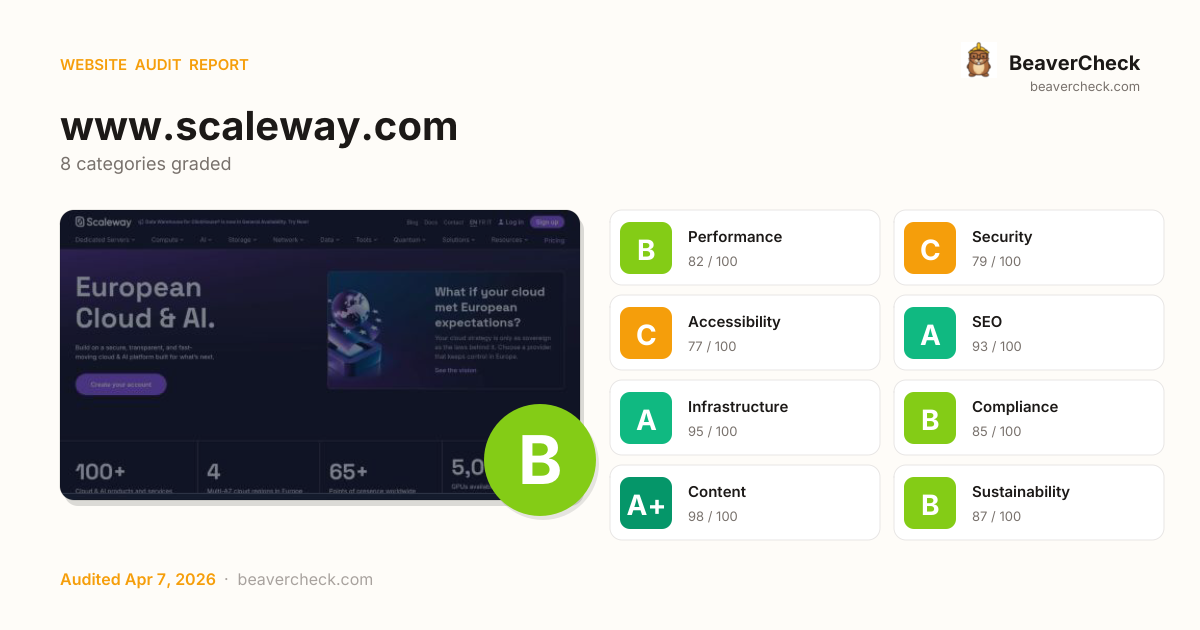
Audit overview
All categories sit comfortably above the 70 threshold; this is a clean audit.
Fix Priority Matrix
5 findingsQuick Wins
2High impact, low effort — start here.
Strategic
3High impact, requires investment.
Easy Improvements
0Small gains, minimal effort.
Nothing in this quadrant — good news.
Deprioritize
0Low impact, high effort — do last.
Nothing in this quadrant — good news.
Screenshots


Your mail setup has problems.
scaleway.com fails 1 mail check: No DMARC record found. This is the kind of misconfiguration that sends your mail to spam.
Top Priorities (5)
Cross-Origin-Embedder-Policy header is missing
COEP enforces that all embedded resources opt-in to cross-origin embedding — required for cross-origin isolation features.
Cross-Origin-Opener-Policy header is missing
COOP isolates your top-level browsing context from cross-origin windows — without it, popup-based side-channel attacks remain possible.
HSTS max-age is too short (15552000s, should be ≥ 31536000s)
HSTS is on, but a short max-age means browsers forget the policy sooner than recommended — set >= 1 year.
JavaScript is 982 KB — consider code splitting or lazy loading
JavaScript bundle is large — code-split routes and lazy-load off-screen components to defer.
No DMARC record found
Without DMARC, anyone can send phishing emails using your domain name.
Business case
What fixing the audit's findings is worth -- and what ignoring them keeps costing.
Return on investment
€878 investment → €5,161/month returns + EUR 20,500,000 risk avoided
Figures combine localized regulatory fine ceilings, search/conversion value priced against local CPC, and bandwidth waste estimates. Results depend on implementation quality and audience composition. Not legal or financial advice.
Conversion barriers
4 barrier(s) likely increasing bounce by ~23%.
- Page takes 11.4s to loadUsers abandon at ~3s — you're 8.9s over the 2.5s threshold→ Optimize render-blocking resources, preload the hero image, and compress images
- Page feels frozen for 1.1sClicks on the primary CTA are ignored while JavaScript runs→ Break up long tasks; defer non-critical JavaScript to post-hydration
- HSTS is enabled but max-age is short (15552000s)First-visit protection is in place, but browsers forget the policy sooner than recommended→ Raise Strict-Transport-Security max-age to at least 31536000 (1 year)
- Content is hard to readGraduate-level reading difficulty — limits the addressable audience for product or blog pages→ Shorten sentences; replace jargon with plain language; target Flesch ease ≥60
Preliminary CRO audit — each barrier links to the tab with detailed analysis.
Remediation cost
Start here for the best return on investment
Cost by category
Cost by effort level
Adjust assumptions
Team composition
Multiplier applied to dev hours to reflect QA, design, and PM overhead. Use Dev only for solo work; Full team for projects with formal review processes.
Rates reflect fully-loaded developer cost including overhead
Warning:Cost of inaction
Compliance Risk
€20.500.000
- No privacy policy link detectedGDPR: EUR 10.000 – EUR 20.000.000
- 2 of 2 <nav> elements are unlabeledEAA: EUR 1.000 – EUR 500.000
Bounce-Rate Cost
€5.161 /mo
+23.5pp bounce · ~2,346 lost visitors/mo
CPC: EUR 2.20
Bandwidth Waste
€0,49 /mo
6608.3 MB/mo × 0.074 EUR/GB
- Optimize transfer: save ~661 KB per page loadSaves €0,49/mo
Compliance figures represent the statutory maximum fine for the most severe triggered category, capped per regulation — not the sum of per-finding penalties. Based on published regulatory fine ranges. This is not legal advice.
Unique monthly visitors from your analytics
Purchases, signups, or key actions
Optional — for revenue estimation
more engaged visitors from reduced bounce
How this is calculated
Based on Google/Deloitte research ("Milliseconds Make Millions") showing a ~7% bounce rate increase per additional second of LCP above the 2.5s "Good" threshold.
Your site's LCP: → estimated after fixes.
These are estimates based on industry research — actual results vary
Your data stays in your browser — nothing is sent to our servers
Lighthouse
Mobile
First Contentful Paint First Contentful Paint — how long until the browser renders the first piece of content. Under 1.8s is good.
3.20 s
Largest Contentful Paint Largest Contentful Paint — how long until the largest visible element loads. Under 2.5s is good.
11.40 s
Total Blocking Time Total Blocking Time — total time the main thread was blocked, preventing user input. Under 200ms is good.
1.11 s
Cumulative Layout Shift Cumulative Layout Shift — measures visual stability. How much the page layout shifts during loading. Under 0.1 is good.
0.000
Speed Index Speed Index — how quickly content is visually displayed during load. Under 3.4s is good.
6.23 s
Time to Interactive Time to Interactive — how long until the page is fully interactive and responds to user input. Under 3.8s is good.
11.55 s
Desktop
First Contentful Paint First Contentful Paint — how long until the browser renders the first piece of content. Under 1.8s is good.
646 ms
Largest Contentful Paint Largest Contentful Paint — how long until the largest visible element loads. Under 2.5s is good.
2.19 s
Total Blocking Time Total Blocking Time — total time the main thread was blocked, preventing user input. Under 200ms is good.
96 ms
Cumulative Layout Shift Cumulative Layout Shift — measures visual stability. How much the page layout shifts during loading. Under 0.1 is good.
0.000
Speed Index Speed Index — how quickly content is visually displayed during load. Under 3.4s is good.
1.42 s
Time to Interactive Time to Interactive — how long until the page is fully interactive and responds to user input. Under 3.8s is good.
2.29 s
Categories
8Performance
JavaScript is 982 KB — consider code splitting or lazy loading
Security
Cross-Origin-Embedder-Policy header is missing
Accessibility
All checks pass
SEO
All checks pass
Infrastructure
All checks pass
Compliance
All checks pass
Content
All checks pass
Sustainability
All checks pass
How you compare
Where this site stands against peers running the same stack.
Top 10% of HSTS sites score 95+ on Performance; you're at 82 — closing this gap is the highest-leverage improvement.
Top 10% of HTTP/3 sites score 96+ on Performance; you're at 82 — closing this gap is the highest-leverage improvement.
Technology stack
HSTS, on Turbopack, hosted on Next.js, with Cloudflare CDN
Stack Architecture
 GrowthBook 1.6.1
 HTTP/3
  Open Graph
  React
React  Sentry
  Webpack
  Turbopack
  Cloudflare
  Envoy
Envoy  Next.js 16.2.1
All Detected Technologies (11)
Cloudflare is a web-infrastructure and website-security company, providing content-delivery-network services, DDoS mitigation, Internet security, and distributed domain-name-server services.
Envoy is an open-source edge and service proxy, designed for cloud-native applications.
Next.js is a React framework for developing single page Javascript applications.
Turbopack is an incremental bundler for JavaScript and TypeScript, written in Rust and integrated into the Next.js framework for optimized build performance.
HTTP Strict Transport Security (HSTS) informs browsers that the site should only be accessed using HTTPS.
HTTP/3 is the third major version of the Hypertext Transfer Protocol used to exchange information on the World Wide Web.
Open Graph is a protocol that is used to integrate any web page into the social graph.
React is an open-source JavaScript library for building user interfaces or UI components.
Sentry is an open-source platform for workflow productivity, aggregating errors from across the stack in real time.
Webpack is an open-source JavaScript module bundler.
GrowthBook is a platform for product teams to run and track experiments, analyze results, and make data-driven decisions to optimize their products for growth.
Observations (2)
No build tool detected
A framework (HSTS) was detected but no bundler was identified. The build tool may not be detectable from output patterns, or the site may use the framework's built-in bundler.
Complex technology stack detected
11 technologies identified. A complex stack increases maintenance burden and attack surface. Consider whether all components are actively needed.
Show your score
Drop this badge on your README, marketing site, or status page. It auto-updates every time the audit re-runs and links back to this report.

This badge auto-updates with your latest scan result.
[](https://beavercheck.com/sites/scaleway.com)<a href="https://beavercheck.com/sites/scaleway.com"><img src="https://beavercheck.com/badge?url=https%3A%2F%2Fwww.scaleway.com" alt="BeaverCheck Score"></a>https://beavercheck.com/badge?url=https%3A%2F%2Fwww.scaleway.comExport & share
Download the audit, share with your team, or grab a fix plan ready to copy into your tracker.
Copies markdown to clipboard
Fix Plan
Three-week roadmap to ship the audit's findings, with one-click copy targets for your tracker.
Three-week fix plan
3 sprints · 10h total → projected B (88)
Sprint 1: Quick Wins
+2Highest ROI — low effort, high impact
- · HSTS max-age is too short (15552000s, should be ≥ 31536000s)
- · Cross-Origin-Opener-Policy header is missing
Sprint 2: Core Fixes
+1Medium effort, high structural impact
- · Cross-Origin-Embedder-Policy header is missing
- · No DMARC record found
Sprint 3: Strategic Improvements
+1Higher effort, long-term payoff
- · JavaScript is 982 KB — consider code splitting or lazy loading