

Audit overview
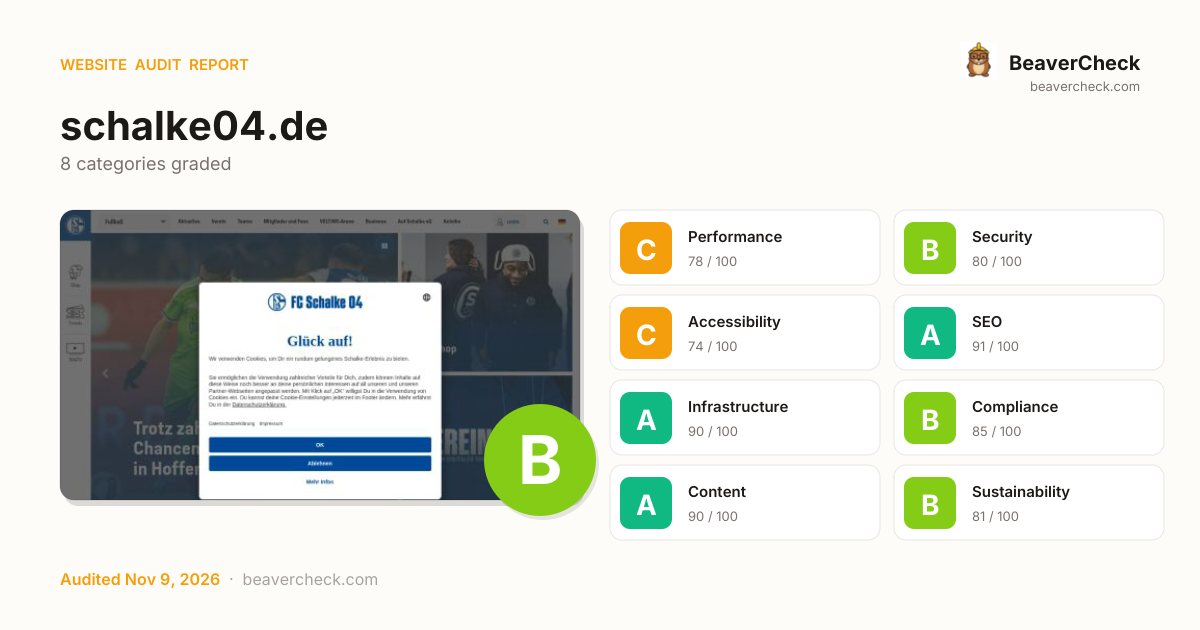
All categories sit comfortably above the 70 threshold; this is a clean audit.
Fix Priority Matrix
5 findingsQuick Wins
3High impact, low effort — start here.
Strategic
2High impact, requires investment.
Easy Improvements
0Small gains, minimal effort.
Nothing in this quadrant — good news.
Deprioritize
0Low impact, high effort — do last.
Nothing in this quadrant — good news.
Screenshots


Top Priorities (5)
Content-Security-Policy header is missing
Without a CSP, a single XSS bug can exfiltrate everything your users type — including credentials.
No <main> landmark found
Without a <main> landmark, screen-reader users can't skip past the navigation to the page content — every page starts with re-reading the menu.
1 software version(s) disclosed in HTML: WPML ver:4.5.5 stt:1,3;
Each disclosed version enables direct CVE lookup -- attacker reads the version, searches the CVE database, targets the site with a tested exploit.
112 third-party resources (49% of weight)
Informational: third-party resource count and their share of page weight. High share caps perf gains from frontend optimization.
200 HTTP requests — consider bundling or reducing
High HTTP request count — bundling, sprite-ing, and HTTP/2 server push can reduce per-request overhead.
Business case
What fixing the audit's findings is worth -- and what ignoring them keeps costing.
Return on investment
€668 investment → €2,820/month returns + EUR 20,500,000 risk avoided
Figures combine localized regulatory fine ceilings, search/conversion value priced against local CPC, and bandwidth waste estimates. Results depend on implementation quality and audience composition. Not legal or financial advice.
Conversion barriers
7 barrier(s) likely increasing bounce by ~30%.
- Page takes 21.0s to loadUsers abandon at ~3s — you're 18.5s over the 2.5s threshold→ Optimize render-blocking resources, preload the hero image, and compress images
- Page feels frozen for 986msClicks on the primary CTA are ignored while JavaScript runs→ Break up long tasks; defer non-critical JavaScript to post-hydration
- Severe layout shift during page loadUsers mis-click when content jumps — converting intent into frustration→ Reserve space for images, ads, and embeds with explicit width/height
- HSTS is enabled but max-age is short (15552000s)First-visit protection is in place, but browsers forget the policy sooner than recommended→ Raise Strict-Transport-Security max-age to at least 31536000 (1 year)
- No Content-Security-Policy headerHigher XSS blast radius — one compromised script can exfiltrate the checkout form→ Ship a reporting-only CSP first, then enforce once violations are clean
Preliminary CRO audit — each barrier links to the tab with detailed analysis.
Remediation cost
Start here for the best return on investment
Cost by category
Cost by effort level
Adjust assumptions
Team composition
Multiplier applied to dev hours to reflect QA, design, and PM overhead. Use Dev only for solo work; Full team for projects with formal review processes.
Rates reflect fully-loaded developer cost including overhead
Warning:Cost of inaction
Compliance Risk
€20.500.000
- 1 advertising/retargeting trackers detectedDSGVO: EUR 10.000 – EUR 20.000.000
- No <main> landmark foundEAA: EUR 1.000 – EUR 500.000
- 4 of 4 <nav> elements are unlabeledEAA: EUR 1.000 – EUR 500.000
Bounce-Rate Cost
€2.819 /mo
+29.7pp bounce · ~2,967 lost visitors/mo
CPC: EUR 0.95
Bandwidth Waste
€0,77 /mo
10434.5 MB/mo × 0.074 EUR/GB
- Optimize transfer: save ~1.0 MB per page loadSaves €0,77/mo
Compliance figures represent the statutory maximum fine for the most severe triggered category, capped per regulation — not the sum of per-finding penalties. Based on published regulatory fine ranges. This is not legal advice.
Unique monthly visitors from your analytics
Purchases, signups, or key actions
Optional — for revenue estimation
more engaged visitors from reduced bounce
Fix 2 critical issues to capture this value
How this is calculated
Based on Google/Deloitte research ("Milliseconds Make Millions") showing a ~7% bounce rate increase per additional second of LCP above the 2.5s "Good" threshold.
Your site's LCP: → estimated after fixes.
These are estimates based on industry research — actual results vary
Your data stays in your browser — nothing is sent to our servers
Lighthouse
Mobile
First Contentful Paint First Contentful Paint — how long until the browser renders the first piece of content. Under 1.8s is good.
8.99 s
Largest Contentful Paint Largest Contentful Paint — how long until the largest visible element loads. Under 2.5s is good.
21.01 s
Total Blocking Time Total Blocking Time — total time the main thread was blocked, preventing user input. Under 200ms is good.
986 ms
Cumulative Layout Shift Cumulative Layout Shift — measures visual stability. How much the page layout shifts during loading. Under 0.1 is good.
0.563
Speed Index Speed Index — how quickly content is visually displayed during load. Under 3.4s is good.
9.59 s
Time to Interactive Time to Interactive — how long until the page is fully interactive and responds to user input. Under 3.8s is good.
22.00 s
Desktop
First Contentful Paint First Contentful Paint — how long until the browser renders the first piece of content. Under 1.8s is good.
1.06 s
Largest Contentful Paint Largest Contentful Paint — how long until the largest visible element loads. Under 2.5s is good.
2.08 s
Total Blocking Time Total Blocking Time — total time the main thread was blocked, preventing user input. Under 200ms is good.
0 ms
Cumulative Layout Shift Cumulative Layout Shift — measures visual stability. How much the page layout shifts during loading. Under 0.1 is good.
0.057
Speed Index Speed Index — how quickly content is visually displayed during load. Under 3.4s is good.
3.91 s
Time to Interactive Time to Interactive — how long until the page is fully interactive and responds to user input. Under 3.8s is good.
2.09 s
Categories
8Performance
112 third-party resources (49% of weight)
Security
Content-Security-Policy header is missing
Accessibility
No <main> landmark found
SEO
All checks pass
Infrastructure
All checks pass
Compliance
All checks pass
Content
All checks pass
Sustainability
All checks pass
How you compare
Where this site stands against peers running the same stack.
Top 10% of Cart Functionality sites score 96+ on SEO; you're at 91 — closing this gap is the highest-leverage improvement.
Top 10% of WordPress sites score 97+ on SEO; you're at 91 — closing this gap is the highest-leverage improvement.
Technology stack
WordPress, on PHP, hosted on Amazon Web Services, with Amazon S3 CDN
Stack Architecture
 DoubleClick Floodlight
 Econda
 Facebook Pixel 2.9.438
 Google Analytics
 Google Tag Manager
 Kameleoon
 The Events Calendar
 WPML 4.5.5
 Yoast SEO
 Cart Functionality
 WordPress
 Bootstrap 4.0.0-alpha.6Facebook Facebook SDK
 Font Awesome
 Google Cloud Storage Google Search Console HSTS Microsoft Microsoft 365
 MobX
 Modernizr 3.6.0
 MySQL
 Open Graph
 Qualtrics
 RequireJS 2.3.6
 Slick
 Tailwind CSS
 Underscore.js 4.17.21
 Usercentrics
 core-js 3.32.2
 jQuery 3.7.1
 PHP
 Amazon S3
 Cloudflare jsDelivr CDN
 Amazon Web Services
 Google Cloud WordPress.com
All Detected Technologies (40)
Amazon S3 or Amazon Simple Storage Service is a service offered by Amazon Web Services (AWS) that provides object storage through a web service interface.
Cloudflare is a web-infrastructure and website-security company, providing content-delivery-network services, DDoS mitigation, Internet security, and distributed domain-name-server services.
Amazon Web Services (AWS) is a comprehensive cloud services platform offering compute power, database storage, content delivery and other functionality.
Google Cloud is a suite of cloud computing services.
WordPress.com is a platform for self-publishing that is popular for blogging and other works.
PHP is a general-purpose scripting language used for web development.
WordPress is a free and open-source content management system written in PHP and paired with a MySQL or MariaDB database. Features include a plugin architecture and a template system.
Websites that have a shopping cart or checkout page, either using a known ecommerce platform or a custom solution.
Bootstrap is a free and open-source CSS framework directed at responsive, mobile-first front-end web development. It contains CSS and JavaScript-based design templates for typography, forms, buttons, navigation, and other interface components.
Font Awesome is a font and icon toolkit based on CSS and Less.
Google Cloud Storage allows world-wide storage and retrieval of any amount of data at any time.
HTTP Strict Transport Security (HSTS) informs browsers that the site should only be accessed using HTTPS.
Modernizr is a JavaScript library that detects the features available in a user's browser.
MySQL is an open-source relational database management system.
Open Graph is a protocol that is used to integrate any web page into the social graph.
Qualtrics is an cloud-based platform for creating and distributing web-based surveys.
RequireJS is a JavaScript library and file loader which manages the dependencies between JavaScript files and in modular programming.
Underscore.js is a JavaScript library which provides utility functions for common programming tasks. It is comparable to features provided by Prototype.js and the Ruby language, but opts for a functional programming design instead of extending object prototypes.
Usercentrics is a SaaS enterprise solution for Consent Management (CMP) that helps enterprise customers to obtain, manage and document the user consent.
core-js is a modular standard library for JavaScript, with polyfills for cutting-edge ECMAScript features.
jQuery is a JavaScript library which is a free, open-source software designed to simplify HTML DOM tree traversal and manipulation, as well as event handling, CSS animation, and Ajax.
Econda is a provider of web analytics solutions for online shops, offering detailed insights into customer behaviour, website performance, and sales optimisation.
Facebook pixel is an analytics tool that allows you to measure the effectiveness of your advertising.
Google Analytics is a free web analytics service that tracks and reports website traffic.
Google Tag Manager is a tag management system (TMS) that allows you to quickly and easily update measurement codes and related code fragments collectively known as tags on your website or mobile app.
Kameleoon is a personalisation technology platform for real-time omnichannel optimisation and conversion.
The Events Calendar is a free event management plugin for WordPress.
WPML plugin makes it possible to build and run fully multilingual WordPress sites.
Yoast SEO is a search engine optimisation plugin for WordPress and other platforms.
Observations (4)
WordPress detected — review security configuration
WordPress sites benefit from: protecting wp-login.php, disabling XML-RPC if unused, restricting REST API access, and keeping all plugins and themes up to date. Check the Security tab for specific findings.
No build tool detected
A framework (Apple) was detected but no bundler was identified. The build tool may not be detectable from output patterns, or the site may use the framework's built-in bundler.
Bootstrap version may be outdated
Detected Bootstrap 4.0.0-alpha.6. The current major version is 5. Consider updating for security patches and new features.
Complex technology stack detected
40 technologies identified. A complex stack increases maintenance burden and attack surface. Consider whether all components are actively needed.
Show your score
Drop this badge on your README, marketing site, or status page. It auto-updates every time the audit re-runs and links back to this report.

This badge auto-updates with your latest scan result.
[](https://beavercheck.com/sites/schalke04.de)<a href="https://beavercheck.com/sites/schalke04.de"><img src="https://beavercheck.com/badge?url=https%3A%2F%2Fschalke04.de" alt="BeaverCheck Score"></a>https://beavercheck.com/badge?url=https%3A%2F%2Fschalke04.deExport & share
Download the audit, share with your team, or grab a fix plan ready to copy into your tracker.
Copies markdown to clipboard
Fix Plan
Three-week roadmap to ship the audit's findings, with one-click copy targets for your tracker.
Three-week fix plan
2 sprints · 7h total → projected B (89)
Sprint 1: Quick Wins
+3Highest ROI — low effort, high impact
- · No <main> landmark found
- · 112 third-party resources (49% of weight)
- · 1 software version(s) disclosed in HTML: WPML ver:4.5.5 stt:1,3;
Sprint 2: Core Fixes
+4Medium effort, high structural impact
- · Content-Security-Policy header is missing
- · 200 HTTP requests — consider bundling or reducing