

Audit overview
4 categories need attention: Security, and 3 others.
Fix Priority Matrix
5 findingsQuick Wins
2High impact, low effort — start here.
Strategic
3High impact, requires investment.
Easy Improvements
0Small gains, minimal effort.
Nothing in this quadrant — good news.
Deprioritize
0Low impact, high effort — do last.
Nothing in this quadrant — good news.
Screenshots


Top Priorities (5)
Content-Security-Policy header is missing
Without a CSP, a single XSS bug can exfiltrate everything your users type — including credentials.
HSTS header is missing
Without HSTS, a network attacker can downgrade the very first connection to HTTP and steal the user's session.
No Content-Security-Policy header found
Without a CSP, a single XSS bug can exfiltrate everything users type — credentials, payment data, session tokens.
1 image(s) missing alt attribute
Each image without alt text is a WCAG 1.1.1 failure — invisible to screen-reader users, lost from Google Image Search.
No <main> landmark found
Without a <main> landmark, screen-reader users can't skip past the navigation to the page content — every page starts with re-reading the menu.
Business case
What fixing the audit's findings is worth -- and what ignoring them keeps costing.
Return on investment
£594 investment → £7,896/month returns + GBP 17,550,000 risk avoided
Figures combine localized regulatory fine ceilings, search/conversion value priced against local CPC, and bandwidth waste estimates. Results depend on implementation quality and audience composition. Not legal or financial advice.
Conversion barriers
10 barrier(s) likely increasing bounce by ~34%.
- No viewport meta tagMobile browsers render at desktop width and shrink — text unreadable, tap targets miniature→ Add <meta name="viewport" content="width=device-width, initial-scale=1">
- Page loads in 3.1sEvery additional 100ms above 2.5s costs conversions — you're 554ms over→ Target <2.5s LCP: defer non-critical scripts and optimize the hero image
- High main-thread blocking timePage is non-interactive for 290ms after first paint→ Defer third-party scripts and split large bundles
- No HSTS headerReturning visitors are briefly exposed to downgrade attacks on first request→ Set Strict-Transport-Security: max-age=31536000; includeSubDomains
- No Content-Security-Policy headerHigher XSS blast radius — one compromised script can exfiltrate the checkout form→ Ship a reporting-only CSP first, then enforce once violations are clean
Preliminary CRO audit — each barrier links to the tab with detailed analysis.
Remediation cost
Start here for the best return on investment
Cost by category
Cost by effort level
Adjust assumptions
Team composition
Multiplier applied to dev hours to reflect QA, design, and PM overhead. Use Dev only for solo work; Full team for projects with formal review processes.
Rates reflect fully-loaded developer cost including overhead
Warning:Cost of inaction
Compliance Risk
£17,550,000
- No privacy policy link detectedUK GDPR: GBP 10,000 – GBP 17,500,000
- Privacy Policy not detectedUK GDPR: GBP 10,000 – GBP 17,500,000
- No <main> landmark foundEquality Act 2010: GBP 500 – GBP 50,000
Bounce-Rate Cost
£7,082 /mo
+33.7pp bounce · ~3,372 lost visitors/mo
CPC: GBP 2.10
Bandwidth Waste
£0.04 /mo
590.2 MB/mo × 0.063 GBP/GB
- Optimize transfer: save ~59 KB per page loadSaves £0.04/mo
Compliance figures represent the statutory maximum fine for the most severe triggered category, capped per regulation — not the sum of per-finding penalties. Based on published regulatory fine ranges. This is not legal advice.
Unique monthly visitors from your analytics
Purchases, signups, or key actions
Optional — for revenue estimation
more engaged visitors from reduced bounce
Fix 5 critical issues to capture this value
How this is calculated
Based on Google/Deloitte research ("Milliseconds Make Millions") showing a ~7% bounce rate increase per additional second of LCP above the 2.5s "Good" threshold.
Your site's LCP: → estimated after fixes.
These are estimates based on industry research — actual results vary
Your data stays in your browser — nothing is sent to our servers
Lighthouse
Mobile
First Contentful Paint First Contentful Paint — how long until the browser renders the first piece of content. Under 1.8s is good.
3.05 s
Largest Contentful Paint Largest Contentful Paint — how long until the largest visible element loads. Under 2.5s is good.
3.05 s
Total Blocking Time Total Blocking Time — total time the main thread was blocked, preventing user input. Under 200ms is good.
290 ms
Cumulative Layout Shift Cumulative Layout Shift — measures visual stability. How much the page layout shifts during loading. Under 0.1 is good.
0.000
Speed Index Speed Index — how quickly content is visually displayed during load. Under 3.4s is good.
3.05 s
Time to Interactive Time to Interactive — how long until the page is fully interactive and responds to user input. Under 3.8s is good.
4.59 s
Desktop
First Contentful Paint First Contentful Paint — how long until the browser renders the first piece of content. Under 1.8s is good.
895 ms
Largest Contentful Paint Largest Contentful Paint — how long until the largest visible element loads. Under 2.5s is good.
895 ms
Total Blocking Time Total Blocking Time — total time the main thread was blocked, preventing user input. Under 200ms is good.
28 ms
Cumulative Layout Shift Cumulative Layout Shift — measures visual stability. How much the page layout shifts during loading. Under 0.1 is good.
0.000
Speed Index Speed Index — how quickly content is visually displayed during load. Under 3.4s is good.
895 ms
Time to Interactive Time to Interactive — how long until the page is fully interactive and responds to user input. Under 3.8s is good.
1.19 s
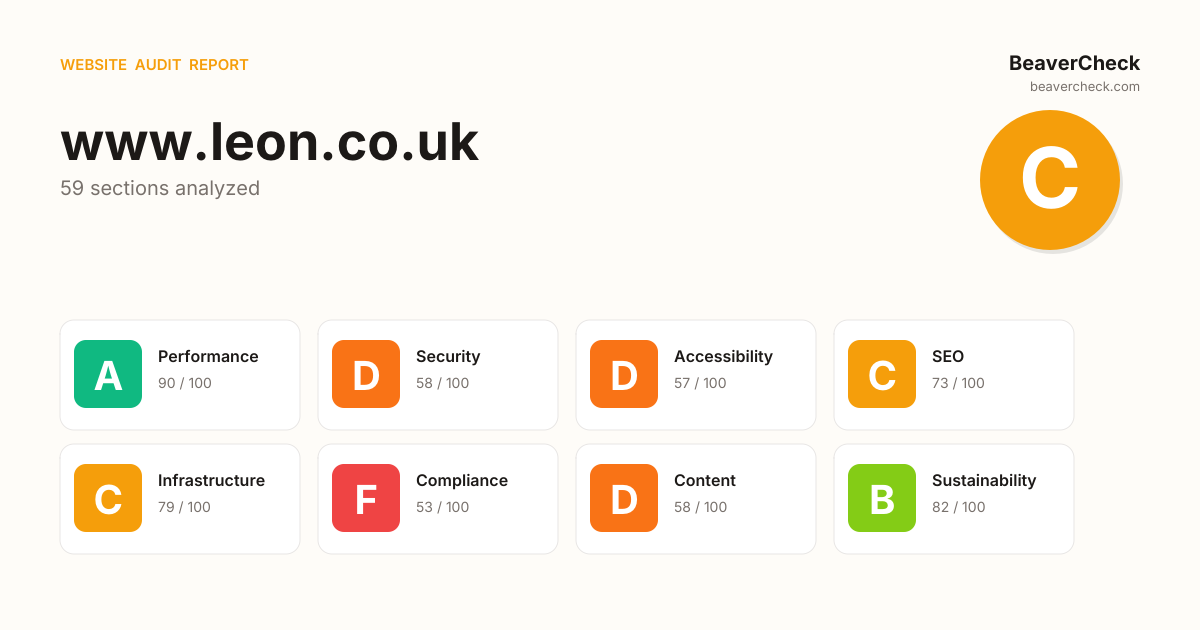
Categories
8Performance
All checks pass
Security
Content-Security-Policy header is missing
Accessibility
1 image(s) missing alt attribute
SEO
All checks pass
Infrastructure
All checks pass
Compliance
All checks pass
Content
All checks pass
Sustainability
All checks pass
How you compare
Where this site stands against peers running the same stack.
Top 10% of Google Font API sites score 96+ on SEO; you're at 73 — closing this gap is the highest-leverage improvement.
Top 10% of Google Analytics sites score 96+ on SEO; you're at 73 — closing this gap is the highest-leverage improvement.
Technology stack
Google Font API
Stack Architecture
 Google Analytics
  Google Tag Manager
  Google Font API
 All Detected Technologies (3)
Google Font API is a web service that supports open-source font files that can be used on your web designs.
Google Analytics is a free web analytics service that tracks and reports website traffic.
Google Tag Manager is a tag management system (TMS) that allows you to quickly and easily update measurement codes and related code fragments collectively known as tags on your website or mobile app.
Observations (1)
No build tool detected
A framework (Google Font API) was detected but no bundler was identified. The build tool may not be detectable from output patterns, or the site may use the framework's built-in bundler.
Show your score
Drop this badge on your README, marketing site, or status page. It auto-updates every time the audit re-runs and links back to this report.

This badge auto-updates with your latest scan result.
[](https://beavercheck.com/sites/leon.co.uk)<a href="https://beavercheck.com/sites/leon.co.uk"><img src="https://beavercheck.com/badge?url=https%3A%2F%2Fwww.leon.co.uk" alt="BeaverCheck Score"></a>https://beavercheck.com/badge?url=https%3A%2F%2Fwww.leon.co.ukExport & share
Download the audit, share with your team, or grab a fix plan ready to copy into your tracker.
Copies markdown to clipboard
Fix Plan
Three-week roadmap to ship the audit's findings, with one-click copy targets for your tracker.
Three-week fix plan
2 sprints · 8h total → projected C (79)
Sprint 1: Quick Wins
+4Highest ROI — low effort, high impact
- · No <main> landmark found
- · HSTS header is missing
Sprint 2: Core Fixes
+5Medium effort, high structural impact
- · 1 image(s) missing alt attribute
- · Content-Security-Policy header is missing
- · No Content-Security-Policy header found