

Content
· 5 checks — Internal links, mixed-content guards, Open Graph previews, and structured data rolled into one auditable list.DBrand PresenceActionSite-name consistency, favicon, social image, meta tags, schema, and contact signalsFIX
Brand Presence
Your brand name differs across channels — visitors see inconsistent identity.
D
46/100
Site name appears as
| Page title | Народ.РУ | |
| og:site_name | — | |
| twitter:site | @ucoz_ru | |
| Organization.name | — |
Inconsistent — names differ across channels
Brand assets
Favicon
8/15single size only
Social share image
14/20og:image set; twitter:image missing
Meta completeness
14/20Organization schema
0/15Contact info discoverable
5/10contact page
Findings
- Brand name differs across channels — users see inconsistent identity
- Add twitter:image — Twitter falls back to og:image only when it's larger than 300×157
- Single favicon only — add apple-touch-icon for iOS home-screen and high-DPI support
- No Organization schema — Google can't render your logo in the knowledge panel
- Only partial contact info discoverable — consider adding a dedicated contact page or mailto/tel link
How consistently your brand appears across channels — shared link previews, structured data, favicon, contact info.
BOpen GraphOpen Graph tags are partially configured — some improvements recommended.REVIEW
The og:description tag controls the description in social sharing previews.
No og:description means social cards either show no subtitle or scrape the first paragraph — usually unflattering.
Learn more ▾ ▴
Without og:description, social platforms either render no subtitle or pull whatever text appears first on the page. The first paragraph is rarely written for share-card context. A purpose-written 150-200 character og:description gives a polished card.
Source: Open Graph Protocol
The og:site_name tag displays the website name in social previews.
Without og:site_name, social cards omit the brand attribution — users see the post but not who published it.
Learn more ▾ ▴
og:site_name appears in the social card chrome (above the title in Facebook/LinkedIn previews). Without it, posts read as anonymous URLs. Set it to your brand name to get free attribution on every share.
Source: Open Graph Protocol
Preview
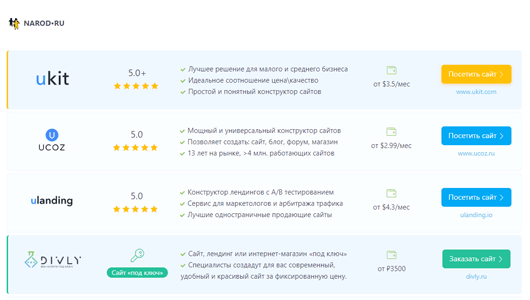
narod.ru
Лучшие конструкторы сайтов | Народный рейтинг
No description
Title will be truncated (84 chars / 70 max)
Description will be truncated (245 chars / 200 max)
- twitter:card — summary_large_image
- twitter:title — Лучшие конструкторы сайтов | Народный рейтинг
- twitter:description — falling back from <meta name=description>
- twitter:image — falling back from og:image
Title will be truncated on Twitter/X (84 chars, max 70)
→ Shorten the title to ≤70 characters
Description will be truncated on Twitter/X (245 chars, max 200)
→ Tighten the description to ≤200 characters
NAROD.RU
Лучшие конструкторы сайтов | Народный рейтинг
No description
Title will be truncated (84 chars / 60 max)
Description will be truncated (245 chars / 155 max)
- og:title — Лучшие конструкторы сайтов | Народный рейтинг
- og:description — falling back from <meta name=description>
- og:image — https://narod.ru/main.png
- og:type — article
- og:url — https://narod.ru/
- og:site_name — Add og:site_name — Recommended — site-level brand line in the preview
Title will be truncated on Facebook (84 chars, max 60)
→ Shorten og:title to ≤60 characters
Description will be truncated on Facebook (245 chars, max 155)
→ Tighten og:description to ≤155 characters
Лучшие конструкторы сайтов | Народный рейтинг
narod.ru
Description will be truncated (245 chars / 150 max)
- og:title — Лучшие конструкторы сайтов | Народный рейтинг
- og:description — falling back from <meta name=description>
- og:image — https://narod.ru/main.png
Description will be truncated on LinkedIn (245 chars, max 150)
→ Tighten og:description to ≤150 characters
narod.ru
Лучшие конструкторы сайтов | Народный рейтинг
No description
- og:title — Лучшие конструкторы сайтов | Народный рейтинг
- og:description — falling back from <meta name=description>
- og:image — https://narod.ru/main.png
Social preview quality
Averaged across Twitter/X, Facebook, LinkedIn, and Slack.
| Field | Twitter/X | Slack | ||
|---|---|---|---|---|
| og:title | ||||
| og:description | ⚠ | ⚠ | ⚠ | |
| og:image | ||||
| og:type | ||||
| og:url | ||||
| og:site_name | ||||
| twitter:card | — | — | — | |
| twitter:title | — | — | — | |
| twitter:description | ⚠ | — | — | — |
| twitter:image | ⚠ | — | — | — |
CStructured DataActionNo structured data (JSON-LD) found.REVIEW
Adding structured data helps search engines understand your content and can enable rich results.
Without schema.org markup, your pages can't appear as rich results (stars, FAQs, recipes) in search.
Learn more ▾ ▴
Structured data is what unlocks rich snippets — review stars, FAQ accordions, recipe cards, breadcrumbs, etc. — that take up more SERP space and dramatically improve click-through. The schema.org vocabulary is well-documented and JSON-LD is the easiest format.
Source: Google Search Central / schema.org
No structured data found
Structured data (JSON-LD) helps search engines understand your content better. Adding it can improve your search result appearance.
Common types include:
- WebSite — your site identity and search box
- Organization — your company information
- Article — blog posts and news articles
- Product — e-commerce product pages
- BreadcrumbList — navigation paths